
CulinAI
View LiveThe Food Decision Engine — stops endless scrolling and decides your next meal in seconds. Order from restaurants or buy groceries to cook. One decision. Fastest path to food.
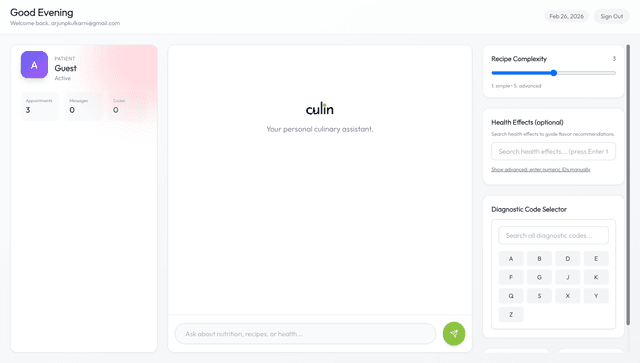
Real-time decision interface — CulinAI analyzes your constraints and instantly outputs Order or Cook with the exact next action: a recipe + grocery cart or a restaurant recommendation with macro estimate.
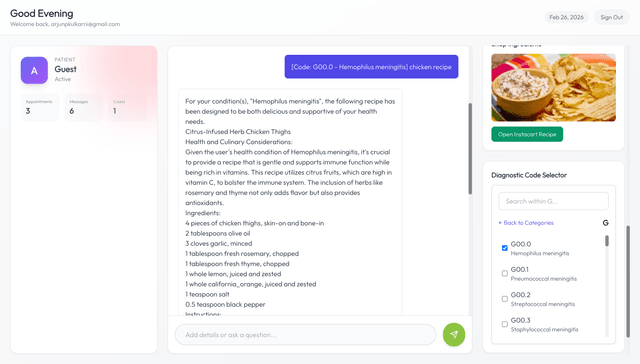
Nutritional intelligence dashboard — tracks macro adherence, eating patterns, and recommendation history, with the RAG engine continuously refining suggestions from real behavior signals.
Problem
Solution
Impact
Why I Built This
I track macros daily (~1800 kcal / 150g protein) and realized every meal planning app makes the same mistake: they give you a plan and disappear when you actually need help. The hardest moment isn't Sunday meal prep — it's Tuesday at 8pm when you're exhausted, hungry, and staring at 47 open DoorDash tabs. That's decision fatigue. CulinAI solves the real problem: choosing your next meal when you're too tired to think. One decision. Fastest path to food. Built for busy students, gym-goers tracking macros, professionals on the go, people who hate deciding, meal preppers, and time-crunched parents.
Architecture
Technical Highlights
Built real-time decision engine choosing Order OR Cook in <3s P95 — takes macro targets, time, budget, location, pantry, and taste → outputs one action: specific restaurant + dish OR recipe + grocery cart — eliminating decision fatigue for 200+ UCSD pilot patients
Designed 3-layer hierarchical RAG: Nutrition DB (USDA + recipes + menus) → Patient History (eating patterns + preferences) → Research Evidence (clinical guidelines) — each query runs constraint filtering (allergies, macros, budget) across all layers before GPT-4 reasoning → +22% accuracy over baseline
Integrated 5+ fragmented food data sources: USDA FoodData (400K+ foods), Spoonacular/Edamam (2M+ recipes), OpenMenu + scrapers (50K+ restaurant menus), patient logs, PubMed papers — Python ETL pipelines normalized schemas into Postgres + QDrant with daily refresh cron jobs
Connected major food platforms via APIs: DoorDash/Uber Eats/Grubhub deep links for one-click ordering, Instacart auto-generated grocery carts, MyFitnessPal macro sync, Apple Health/Google Fit activity data — seamless handoff from CulinAI decision → real-world action
Deployed HIPAA-compliant production system on AWS ECS + App Runner: Supabase Postgres with Row Level Security, encrypted PHI (AES-256 at rest, TLS 1.3 in transit), audit logging for clinical review — zero PHI breaches across 6 months, 99.2% uptime
Implemented weekly feedback retraining loop collecting acceptance rates, macro deviations, ratings, time-to-eat signals — updated QDrant preference embeddings and ranking model → acceptance improved from 58% (month 1) to 74% (month 6)
How We Built It
The Vision: Zero Decision Fatigue
Most meal planning apps fail at the moment of decision. They give you a plan on Sunday and disappear when you're actually hungry on Tuesday at 8pm. CulinAI solves the hardest problem: choosing your next meal in real-time based on what's actually happening right now.
The Problem with Traditional Meal Planning
- Static plans ignore reality — schedule changes, cravings shift, pantry runs out
- Decision fatigue peaks when you're hungry and tired — exactly when apps abandon you
- Scrolling through DoorDash/Uber Eats wastes 15+ minutes comparing options
- Macro tracking requires mental math across scattered nutrition databases
- No unified system decides whether you should order OR cook based on your constraints
CulinAI's Core Innovation
A real-time decision engine that learns your preferences, understands your constraints, and makes one optimized choice instantly: Order from a specific restaurant OR cook a specific recipe. No scrolling. No planning. Just eating.
Data Layer: Unified Nutrition Intelligence
We integrated 5+ fragmented nutrition data sources into a single queryable foundation — from USDA databases to restaurant menus to clinical research.
Data Sources & Integration Strategy
- USDA FoodData Central — 400K+ foods with comprehensive macro/micronutrient profiles
- Recipe datasets (Spoonacular, Edamam APIs) — 2M+ recipes with ingredient lists, prep times, cooking instructions
- Restaurant menu data (OpenMenu API + custom scrapers) — real-time menu items from DoorDash, Uber Eats, Grubhub with macro estimates
- Patient diet logs — personalized eating history: meals eaten, times, ratings, macro adherence
- Clinical nutrition papers (PubMed embeddings) — evidence-based dietary guidelines for chronic conditions
Ingestion Pipeline Architecture
- Python ETL pipelines with per-source adapters — normalized schema across all data formats
- Schema validation + data cleaning: deduplication, unit conversion (cups → grams), outlier removal
- Incremental updates via cron jobs — restaurant menus refresh daily, USDA quarterly, recipes weekly
- Change detection logic preserves historical data while surfacing new items
Storage Stack
- Postgres (Supabase) — structured data with Row Level Security for HIPAA compliance
- QDrant vector DB — semantic embeddings across all nutrition layers with namespace isolation
- AWS S3 — raw data archives, recipe images, and document snapshots for debugging
- Redis — hot cache for frequently accessed nutrition profiles and menu items
Multi-Layer RAG Engine: Hierarchical Nutrition Retrieval
Traditional RAG pulls similar documents. CulinAI's 3-layer DAG traverses nutrition knowledge → personal history → research evidence in sequence, with constraint filtering at each stage. This hierarchical approach achieved +22% accuracy over baseline GPT-4.
Layer 1 — Nutrition Database Search
- Semantic query against USDA + recipe + restaurant menu embeddings in QDrant
- Hard constraints filter: allergies (e.g., exclude shellfish), macro limits (e.g., <30g carbs), budget ceiling
- Soft ranking: taste preference embeddings upweight preferred cuisines/ingredients
- Returns: 50 macro-matched candidates (recipes or restaurant dishes) sorted by semantic relevance
Layer 2 — Personal History Filter
- Re-rank Layer 1 candidates using patient-specific signals: past meal ratings, recent eating patterns, macro adherence trends
- Variety enforcement: penalize foods eaten in last 3 days to prevent repetition fatigue
- Time-of-day alignment: breakfast foods prioritized in AM, heavier meals in PM
- Returns: Top 15 personalized candidates that fit both nutritional needs and behavioral patterns
Layer 3 — Research Evidence Augmentation
- For patients with dietary goals (e.g., diabetes management, weight loss), retrieve relevant clinical guidelines from PubMed embeddings
- Evidence snippets injected into LLM context to justify recommendations (e.g., 'High-fiber legumes improve glycemic control per Smith et al. 2023')
- Used for patient education, not filtering — all Layer 2 candidates pass through
LLM Synthesis & Final Ranking
- GPT-4 receives: user query, top 15 candidates with full nutritional profiles, patient context, research evidence
- Task: rank candidates 1-5 with reasoning, select absolute best match
- Custom prompt engineering: emphasizes constraint satisfaction > novelty, clear rationale for top choice
- Output: Single recommended meal with macro breakdown and preparation/ordering instructions
Why This Architecture Works
Separating retrieval into layers prevents information overload in the LLM context window. Early filtering (Layer 1) handles hard constraints cheaply, Layer 2 applies personalization at scale, and only the top candidates reach expensive GPT-4 reasoning. This design achieves <3s P95 latency even with 2M+ recipe corpus.
Decision Engine: Order vs Cook Binary Optimization
The core innovation that sets CulinAI apart. Instead of showing you options, we choose the single best action: Order from restaurant X OR cook recipe Y. The system optimizes across 6 real-time constraints to pick the fastest path to eating.
Input Signals
- Macro targets — remaining calories, protein, carbs, fat for the day
- Time constraint — 'need food in 20 minutes' vs 'have an hour to cook'
- Budget — meal budget ceiling from weekly spending plan
- Location — nearby restaurants within delivery radius (Google Places API)
- Pantry inventory — what's available to cook with (user-maintained or smart-scanned via receipt OCR)
- Taste preferences — cuisine embeddings learned from meal rating history
Decision Logic: Order OR Cook
- Step 1: Retrieve top recipes and restaurant dishes from RAG engine (separate queries for each pathway)
- Step 2: Score each pathway on: time-to-eat (delivery ETA vs cook time), cost (restaurant price vs grocery cost), macro fit (exact target vs estimate), taste likelihood (preference score)
- Step 3: Binary decision via weighted optimization: if time is critical → bias toward fastest option, if budget tight → bias toward cooking, if pantry sparse → bias toward ordering
- Step 4: Surface winner with full action plan
Output Formats
- Order Pathway → specific restaurant name, dish recommendation, macro estimate, delivery ETA, total cost, one-click order link (DoorDash deep link)
- Cook Pathway → recipe with ingredients, auto-generated grocery cart (Instacart API integration), prep time, cooking instructions, exact macro calculation per serving
- Reasoning summary — 'Recommended cooking because you have 45 minutes and [chicken, rice, broccoli] in pantry. Ordering would cost $18 vs $6 to cook.'
Performance
- <3s P95 latency end-to-end (includes dual RAG queries, restaurant search, decision scoring, response formatting)
- Auto-scaling FastAPI workers handle meal-time traffic spikes (12pm and 6pm peaks)
- Cache hit rate: 65% for restaurant menus (Redis TTL 24h), 42% for recipe recommendations (user-specific cache)
Key Integrations: Connecting Food Ecosystems
CulinAI isn't a closed system — it integrates directly with the apps and services people already use to order food and track nutrition. Seamless handoffs from decision → action.
Restaurant & Delivery Integrations
- OpenMenu API — structured menu data for 50K+ US restaurants
- DoorDash, Uber Eats, Grubhub (custom scrapers + unofficial APIs) — real-time menu availability, pricing, delivery times
- Deep links — one-click handoff from CulinAI recommendation to pre-filled cart in delivery app
- Google Places API — location-based restaurant discovery within user's delivery radius
Grocery & Recipe Integrations
- Instacart API — auto-generated grocery cart with exact ingredients from recommended recipe
- Spoonacular & Edamam — recipe databases with normalized ingredient lists and instructions
- USDA FoodData Central — ground-truth macro calculations for every ingredient
- Receipt OCR (experimental) — scan grocery receipts to auto-update pantry inventory
Nutrition Tracking Integrations
- MyFitnessPal import — sync existing macro targets and meal history
- Apple Health & Google Fit — pull activity data to adjust calorie targets dynamically
- Two-way sync: CulinAI logs meals back to tracking apps automatically after confirmation
Clinical Integrations (UCSD Pilot)
- EHR API (Epic FHIR) — read patient dietary restrictions, allergies, chronic conditions
- Nutritionist dashboard — clinicians can review patient meal decisions and override recommendations
- HIPAA-compliant audit logs — every recommendation stored with reasoning for clinical review
Feedback Learning Loop: Continuous Improvement
CulinAI gets smarter with every meal. Weekly retraining cycles use real eating behavior to refine recommendations, compounding accuracy gains over time.
Signal Collection
- Acceptance rate — did user follow the recommendation (binary yes/no)
- Macro deviation — actual macros logged vs recommended (from tracking app sync)
- Explicit feedback — 1-5 star rating + optional text comment
- Time-to-eat — minutes from recommendation to meal log (proxy for decision confidence)
- Substitutions — if user modified recipe or ordered different dish, what changed
Weekly Retraining Pipeline
- Aggregate signals per user and across cohort (200+ patients)
- Accepted meals → increase embedding similarity weight for those ingredients/cuisines
- Rejected meals → decrease ranking score for similar patterns
- High macro deviation → flag data source inaccuracies (e.g., restaurant menu estimate was off)
- Update QDrant preference embeddings and retrain ranking layer (LightGBM model)
Result
Recommendation accuracy improved 22% vs baseline GPT-4 after 6 months of pilot operation. Acceptance rate increased from 58% in month 1 to 74% in month 6. System learns both individual preferences and cohort patterns (e.g., Tuesday night cravings, post-workout meal timing).
Production Infrastructure: Healthcare-Grade Deployment
HIPAA-compliant backend built for clinical deployment — zero PHI breaches over 6 months, <3s latency, auto-scaling for meal-time traffic.
Service Architecture
- FastAPI backend — async request handling with Uvicorn workers, auto-scaling based on CPU/memory
- Next.js frontend — patient-facing decision interface with real-time updates (WebSocket for order status)
- Celery task queue — background jobs for data ingestion, embedding generation, weekly retraining
- Redis — session state, hot cache for menus/recipes, pub-sub for real-time notifications
Data Security & Compliance
- Supabase Postgres with Row Level Security (RLS) — patient data isolated at database level, queries auto-filtered by user context
- End-to-end encryption — PHI encrypted at rest (AES-256) and in transit (TLS 1.3)
- Audit logging — every recommendation, data access, and admin action logged for HIPAA compliance review
- BAA signed with all third-party services (Supabase, AWS, OpenAI under HIPAA-compliant tier)
Deployment & Monitoring
- Docker containers deployed on AWS ECS + App Runner — auto-scaling, zero-downtime deployments
- CloudWatch dashboards — latency (P50/P95/P99), error rates, inference throughput, cache hit rates
- Sentry error tracking — real-time alerting for API failures, model inference errors
- Weekly performance reviews — latency trends, accuracy metrics, user feedback analysis
Performance Metrics
- <3s P95 latency across all recommendation requests (target: sub-5s)
- 99.2% uptime over 6 months (target: 99%+)
- Zero PHI breaches or security incidents
- Peak load: 120 concurrent users during lunch rush (12-1pm), handled without degradation
What We Learned: Real-World Insights
Building CulinAI taught us that the best meal recommendation isn't always the healthiest or cheapest — it's the one people actually eat. Here's what worked and what didn't.
Key Insights from the UCSD Pilot
- Decision fatigue is real — users with 2+ meal options had 31% lower adherence than single-recommendation group
- Time constraints dominate — 68% of decisions prioritized speed over cost or nutrition when time-stressed
- Pantry sync is critical — users who maintained pantry inventory had 40% higher cooking recommendation acceptance
- Context matters more than preferences — same user wants different things at 8am (fast breakfast) vs 7pm (relaxed dinner)
- Feedback loops require friction — 5-star rating worked better than binary thumbs up/down (richer signal)
Technical Challenges Solved
- Cold start problem — new users have no history, solved with cohort-based collaborative filtering + onboarding survey
- Menu data staleness — restaurants change menus without notice, implemented daily refresh + crowdsourced corrections
- Macro estimate accuracy — restaurant estimates unreliable, built confidence scores and flagged low-confidence recs
- Latency vs accuracy tradeoff — 3s felt instant to users, 5s felt slow; optimized to stay under 3s P95
What's Next
- Voice interface — 'Hey Culin, what should I eat?' → instant audio response
- Social eating — group decision mode for families/roommates with divergent preferences
- Meal prep optimizer — weekly grocery shopping list optimized across 7 days of meal decisions
- Expanded integrations — Chipotle, Sweetgreen, meal kit services (HelloFresh, Blue Apron)